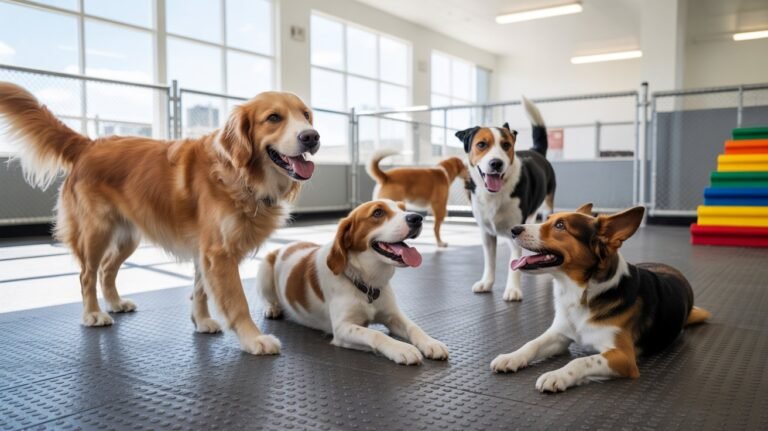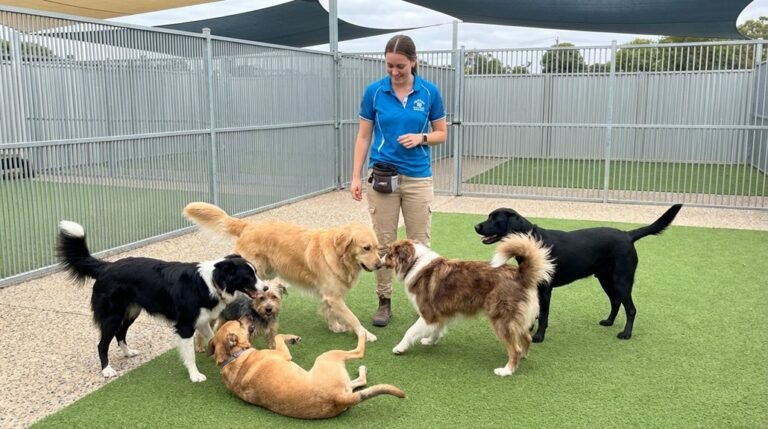

Dog daycare can turn a restless pup into a balanced, content companion — but not every dog thrives in a group setting. Some dogs love the energy and social interaction of structured play, while others need a slower introduction. At Bones N’ Biscuits, we focus on intentional placement, active supervision, and balanced routines to help dogs succeed — not just survive — in daycare.
Why This Matters
- Your dog should complete our enrollment process and structured Meet & Greet before joining group play.
- Your dog should show relaxed body language and appropriate play signals.
- Your dog should respond to basic cues that allow staff to guide transitions smoothly.
- Your dog should recover reasonably well after excitement.
- Group placement should be intentional — matched by size, energy level, and play style.
Age and Enrollment Guidelines
At Bones N’ Biscuits, every dog goes through a structured onboarding process before entering regular playgroups. This ensures each dog is developmentally ready and comfortable with structured group activity.
Daycare works best when introductions are gradual and group placement is intentional.
Enrollment Includes:
- Completed intake forms and emergency contacts
- Notes about routines, energy level, and play preferences
- A structured Meet & Greet evaluation
This information helps us determine pacing, group size, and rest scheduling for your dog’s first visits.
Basic Skills That Support Daycare Success
Dogs who respond to simple cues transition more smoothly within a structured daycare environment.
- “Come” — Allows handlers to redirect quickly during group changes
- “Sit” and “Stay” — Creates calm transitions during check-in and rest breaks
- “Drop it” — Helps prevent tension over objects
- “Leave it” — Supports smooth redirection when needed
At Bones N’ Biscuits, we use structured playgroups and active supervision so dogs can be guided clearly throughout the day.
Understanding Your Dog’s Social Comfort
Before enrolling in daycare, it helps to evaluate how your dog interacts in social settings.
Positive Indicators:
- Approaches other dogs with relaxed posture
- Uses appropriate play signals
- Pauses naturally during play
- Recovers quickly after excitement
Signs Your Dog May Need More Preparation:
- Persistent resource guarding
- Difficulty settling after activity
- Overly pushy or overwhelming play
- Withdrawal from group interaction
Our Meet & Greet allows us to observe these behaviors and recommend the best group fit — or suggest a slower introduction if needed.
How We Structure Play at Bones N’ Biscuits
We don’t believe in chaotic, nonstop play. Structure is key.
- Dogs are grouped by size, temperament, and energy level.
- New dogs start with smaller, controlled introductions.
- Play sessions are rotated with scheduled rest breaks.
- Staff intervene early when energy begins to spike.
- Real-time adjustments keep groups balanced.
This approach helps prevent overwhelm and supports long-term confidence.
Handling Separation and Busy Environments
Daycare involves transitions, activity, and time away from home. Dogs who do best can:
- Recover reasonably quickly after drop-off
- Stay engaged in structured group activity
- Settle during rest periods with guidance
We recommend starting with shorter visits to gauge comfort and gradually building consistency.
Signs Your Dog Is Ready
- Shows relaxed curiosity in new settings
- Engages appropriately with other dogs
- Transitions calmly between play and rest
- Returns home pleasantly tired rather than overstimulated
How to Prepare for Day One
Preparation makes the transition smoother.
- Schedule a facility tour before the first visit.
- Practice short separations at home.
- Reinforce basic cues for easier redirection.
- Start with a half-day visit if possible.
After pickup, look for balanced behavior — calm transitions, relaxed body language, and normal evening routines.
The Bones N’ Biscuits Difference
At Bones N’ Biscuits, daycare isn’t about filling space — it’s about thoughtful structure.
- Structured Meet & Greet evaluations
- Intentional playgroup matching
- Active supervision and early redirection
- Scheduled rest and reset breaks
- Real-time group adjustments throughout the day
When the match is right and structure is in place, daycare becomes an enriching, balanced part of your dog’s routine — and a source of peace of mind for you.